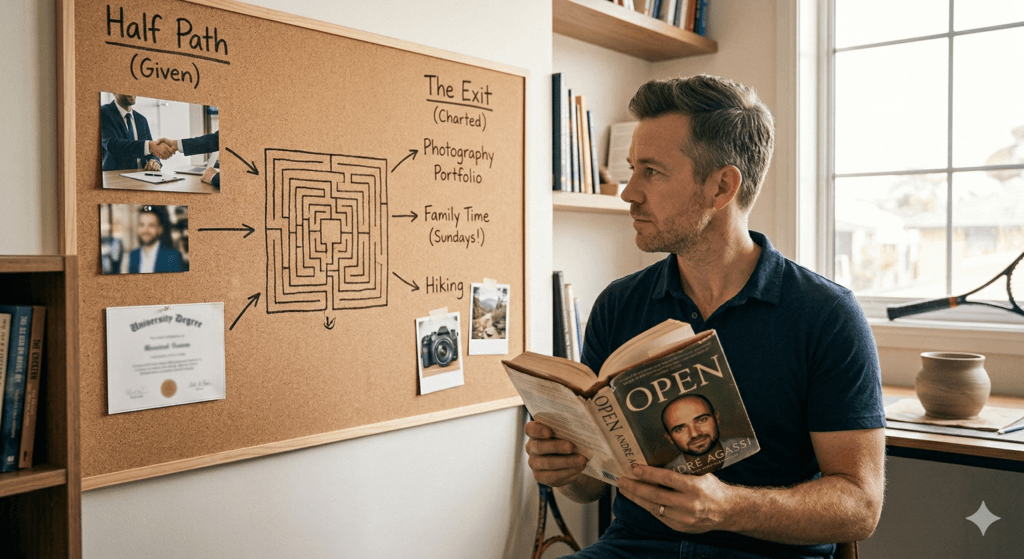
On the 13th day of the Kurukshetra War, a catastrophe loomed over the Pandavas. Guru Dronacharya had formed the Chakravyuha to capture Yudhishthira. Only Arjuna could break the formation completely — but the Kauravas had kept him busy elsewhere. Abhimanyu, Arjuna’s sixteen-year-old son, was the only hope. He knew how to break into the formation. But not how to get out.
The situation was desperate. Abhimanyu entered the Chakravyuha successfully. He was trained by none other than his father, the greatest warrior, Arjuna. But as he entered, Jayadratha sealed the entry behind him. Abhimanyu was cut off from his kin, his support. He had no idea how to get out. So he did what he knew best. He fought valiantly. He killed many high-ranked Kaurava warriors. But eventually, they closed in on him. He had no knowledge to exit the formation. The Kauravas attacked at once, and Abhimanyu died a brave death.
Here’s the backstory. When Arjuna’s wife Subhadra was pregnant with Abhimanyu, Arjuna told her the method to break the Chakravyuha. Abhimanyu listened to this conversation from her womb. But Subhadra fell asleep while listening, and the conversation remained incomplete. Abhimanyu grew up knowing only the half path into the Chakravyuha.
I feel most of us are like Abhimanyu. We grow up knowing only the half path of life.
What is this half path that we are taught?
We are told to work hard, study well, build good values, and achieve security and stability. This path is shaped by the lives of our parents, teachers, and all the well-wishers who influence our childhoods. And many times, this path reflects their unfulfilled dreams and their success stories.
It’s great to have such a path laid out before us as we enter our lives. But we should be mindful — it’s only the half path.
When I was a child, I was a fan of Andre Agassi. Agassi’s father was a former Olympic boxer, obsessed with making his son a tennis champion — to achieve the glory he never fully attained. Much like Abhimanyu listening from the womb, Agassi was “trained” before he could even choose. His father hung tennis balls over his crib and built a machine called “The Dragon” that fired 2,500 balls a day at him.
Agassi followed the “half path” of hard work and extreme discipline. He achieved the security and stability of becoming world #1. But in his autobiography, he famously revealed that he “hated tennis with a dark and secret passion.” He knew how to “enter” the formation of professional success. But because it was his father’s dream and not his own, he had no “exit” — no sense of who he was outside the court. He was trapped and miserable despite his fame.
As I approached middle age, I started noticing the effects of this half knowledge.
I saw a few people who loved their first half path. They found immense happiness in what they did. The thought of choosing any other path never bothered them. These people were okay missing out on exploring other aspects of their lives.
Then there were others who grew frustrated with the first path. To “settle” into life, they had done something against their very nature. They felt the urge to choose an entirely different path — like planning a full career shift. A complete change of path sounds exciting, but it’s risky. You risk everything you’ve achieved.
And then I saw the third kind. People who maintained what they had achieved through hard work. Even if they didn’t feel passionate about what they did, they continued doing it. But because they had already achieved a stable life — reached the centre of their Chakravyuha — they leveraged this advantage. They planned their own path for the second half of life. A path not shaped by someone else’s stories, but their own.
Mid-life is a great part of our lives. Most of us are past the overly stressful, anxious, and even exciting youth. We get a realistic idea of how our lives are going to be.
What we must learn from Abhimanyu’s sacrifice is this: what we followed till now has been only the half path. And it’s time to take the steering wheel of our lives in our own hands. We have to chart our own path in the second half.
When you feel the need for change — either because you’ve achieved the stability you wanted, or because change is forced upon you as you retire — the question to ask is: which aspects of your life remain unexplored?
It can be as simple as making time for family and friends you couldn’t manage during the chaos of early career. Or indulging in a hobby that always gave you deep happiness. For some, it can be as bold as shifting to a new career.
What we must learn from Abhimanyu is this: the half path into the Chakravyuha of life — the one given to us by others — has done its job. Now it’s our turn to chart our way out of the Chakravyuha, on our own terms, with our own responsibility.
Such a great perspective of looking at Abhimanyu’s half won battle and how it reflects on our lives as well.Mahabharata has many lessons for us to learn but the one you expressed is so unique and relevant in current time.
Thanks Akanksha. Glad that it resonated.
We have heard or read this story a thousand times – but this take on it reflects the thoughtfulness of the author! It’s brilliant, and yet, very simple. But that’s life, it’s simple – we just need to see it.
Thank you very much Meena tai. Cannot agree more, we unnecessarily complicate life.
Half path – Simple, thoughtful, and stays with you 🌼
Thank you 😊