The doorbell rang at 10 AM sharp. It rang like that on most days. I grabbed my wallet and ran to the door. Most of my mornings, same routine.
Amazon. Flipkart. Myntra. Nykaa. Some brand I found on Instagram at midnight. Someone always had a package for me. Every time, the courier guy brought my dose of happiness. He probably knew my face better than my neighbours did.
Today: a Nike dry-fit T-shirt. I’d been dreaming about it for weeks. Scrolling past it. Adding it to my cart. Removing it. Adding it again. Finally clicking “Buy Now” at 1 AM when my willpower was at its weakest. I was always dreaming about something. There was always a next purchase waiting in my mind.
I tore open the package. My eyes widened at that shiny piece of cloth. The fabric felt exactly like the reviews promised. I held it up against my chest and imagined wearing it to the gym, looking sharp, feeling confident. I was so lost in admiration that I didn’t notice my wife watching from the corner of the room.
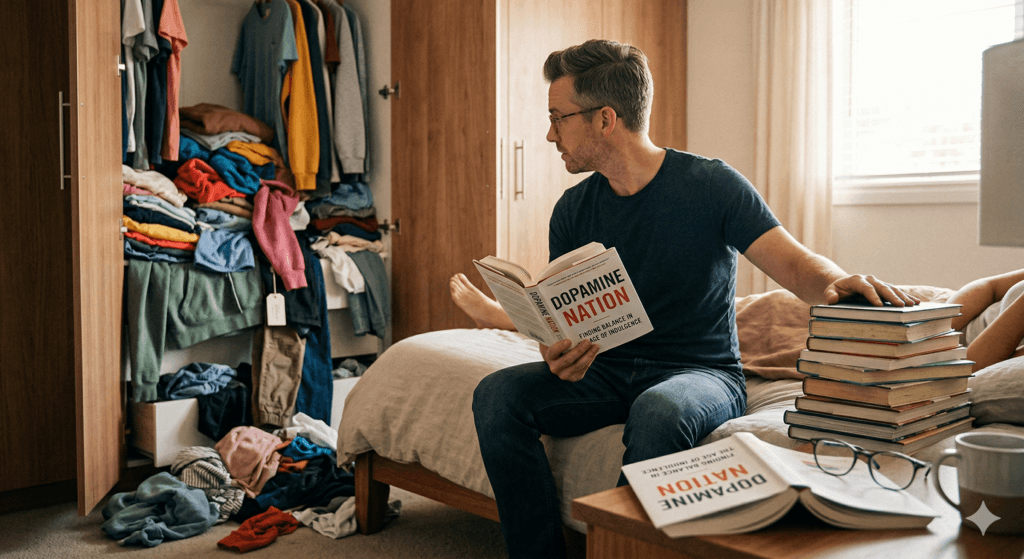
When I finally looked at her, she didn’t say much. She just asked me to open my cupboard and decide where to keep my new possession.
Simple enough, I thought.
I opened it. Two T-shirts tumbled out immediately. The cupboard was overloaded—stuffed with clothes I’d forgotten I owned. Those shirts must have been suffocating in there for months. And I had brought them a new companion—with nowhere to put it.
I stood there holding my shiny new T-shirt, staring at the chaos of fabric spilling out of my wardrobe. I looked back at my wife. She didn’t need to say anything. A sharp thought hit me like a slap.
I had way more than I needed. And I was still hungry.
I sat at the edge of the bed for a long time. The T-shirt lay beside me, tag still attached. Like any good doctor, I decided to take my own case history. I needed to understand what was happening to me.
The Dopamine Trap
As I interviewed myself, asking hard questions about my habits, I remembered my medicine class from post-graduation. We had studied addiction, reward pathways, the chemistry of craving. I was falling victim to something we’d discussed in textbooks: the Dopamine Economy.
I felt constant hunger. Constant desire. Despite being more than full. My cupboard was overflowing, yet my brain kept telling me I needed more. The disconnect was staggering.
My story mirrors many professionals I see around me. I started my practice with enthusiasm, curiosity, and the anxiety every newbie carries. The early years were demanding. Every patient was a learning opportunity. Every case kept me on my toes. I had no time to think about shopping or scrolling.
Then, within a few years, I settled into a rhythm. The work became familiar. The challenges became routine. And that’s when my brain started craving more stimulation.
That was the crucial moment. My dopamine receptors were hungry. They needed feeding.
The world had easy solutions waiting.
After a tiring OPD, exhausted from seeing patient after patient, I’d seek refuge in social media. Just a few minutes of scrolling, I told myself. Just to unwind. The apps did their job well, feeding me cheap dopamine hits with every swipe. One video led to another. One product ad led to a purchase.
Day after day, I saw “sales” and “buy two get two free” and “limited time” deals everywhere. Red banners screaming urgency. Countdown timers creating panic. Influencers showing off their hauls. I placed orders. Sometimes two or three a day.
My brain justified every purchase. Look at the money I saved with that discount. This brand never goes on sale—I’d be foolish to miss it. I deserved this—I worked hard. I earned it. The rationalizations came easy. The orders came easier.
Anna Lembke explains this brilliantly in her book Dopamine Nation. She calls it “Limbic Capitalism.” The term stopped me cold when I first read it. Modern life, she explains, exploits our dopamine system with surgical precision. Everything is engineered to be intense, fast, unpredictable, and instantly accessible.
This constant overstimulation weakens our prefrontal cortex—the part of our brain responsible for long-term thinking and impulse control. We struggle to choose delayed rewards over instant gratification. We lose the ability to find joy in ordinary pleasures. A quiet evening feels boring. A walk in the park feels pointless. We need the ‘kick’. We get stuck in the loop.
I wasn’t really dreaming about clothes. Looking back, I couldn’t even wear half of what I bought. Some items still had tags on them months later. My limbic system had been hijacked by social media marketing. I was a puppet, and the algorithms were pulling my strings.
Today, I want to thank my tiny wardrobe. It saved me.
My cupboard was full. Stuffed to the brim. There was no space for anything new. I physically could not buy another piece of clothing without throwing something away. I had to stop.
The first step of escaping the dopamine trap—abstinence—happened on its own. Not through willpower or discipline, but through the simple limitation of physical space. I used the forced pause to reflect and plan. What was I really doing? Where was this leading?
I was paying a price. Not just money, but peace. I was losing both.
The dopamine surge lasted only until I opened the package. That moment of tearing the cardboard, pulling out the item, seeing it for the first time—that was the peak. Once the mystery was gone, the dopamine faded within minutes. My brain immediately started craving something more. Something bigger. Something newer.
I saw the pattern clearly now. My cravings had shifted from clothes to electronics. A new phone. Wireless earbuds. A smartwatch. The items got more expensive as my tolerance grew. I needed more dopamine, faster. And the internet had an endless supply, available 24 hours a day, delivered to my doorstep.
The full cupboard gave me a chance to step back. I started researching what was happening to my brain. I read articles. Watched documentaries. And then I discovered books on the subject.
I loved Dopamine Nation. It did two things for me. First, it gave me insight into my problem and a framework for solving it. Second, it showed me how deeply satisfying reading could be. The delayed gratification from finishing a book—spending days with an idea, letting it marinate, reaching the final page with a sense of accomplishment—felt richer and more lasting than the instant hit from compulsive shopping.
Through books, I started living lives I’d never live otherwise. I traveled to places I’d never visit. I met people who died centuries ago. I explored ideas that had never crossed my mind. I read one book after another. Some improved my productivity. Others offered emotional support during difficult weeks. Some gave me wisdom I still carry with me. Some painted vivid fairylands that let me escape reality in a healthier way.
Every book changed something inside me. A perspective. A habit. A belief. The changes were subtle but real.
Somewhere in the flow of reading, I escaped the trap without realizing it. The urge to shop faded. The 10 AM doorbell became rare. I had moved from a destructive dopamine habit to a healthy one.
In Sapiens, Yuval Noah Harari notes how the Scientific Revolution brought rapid technological progress and connected the world in unprecedented ways. But it also gave rise to consumerism—the idea that buying things is the path to happiness.
We are targeted constantly. Bombarded with products and their ever-improving features. Every company wants our attention, our clicks, our money. We’re made to believe that material progress leads to fulfilment. That the next purchase will finally make us happy. That we’re just one product away from the life we want.
Every consumer company exploits our dopamine pathways to sell us this belief. They hire the smartest engineers and psychologists to make their apps more addictive, their ads more persuasive, their checkout processes more frictionless. We’re not fighting fair.
I learned one thing from my experience: I swapped compulsive clothes shopping for occasional book shopping. It sounds simple, but the shift was profound. I started buying things that would change me—things that would make me better, wiser, more capable—instead of things that would give me temporary happiness and nothing else.
Now, before I buy anything, I ask myself one question: Will this change me for the better?
If the answer is yes—if the purchase will teach me something, improve my health, deepen a relationship, or genuinely solve a problem—I buy it. If the answer is no—if it’s just another shiny object to fill a void that can’t be filled with objects—I close the tab and walk away.
That’s my shopping protocol. Simple. Powerful. Life-changing.
My doorbell rings occasionally at 10 AM now. Not every day. Not even every week. But when it does, I still rush to the door with my wallet. Old habits leave traces.
But what waits for me now is different. It’s the aroma of a fresh book. The weight of unread pages. A world of wisdom waiting to be explored.
And that feeling lasts far longer than any T-shirt ever could.
Looks true for the younger, new generation. Some of old generation like me don’t use the apps like Amazon, Flipkart, etc daily. Probably that’s why we are not affected. But this I find it with many people.
With your permission, can I forward it to others.
I agree. And overall I have feeling that it’s high time we go back to older wisdom as a reference to solve present day problems. And it would be my immense pleasure if you share the article. Thanks a lot.
This really hit home! There’s a kind of honesty in the way you observe that makes it easy to connect with, and the flow keeps the reader engaged without trying too hard. It’s reflective, insightful, and carries a calm depth that stays with you even after finishing.
Thank you so much for the feedback. Means a lot.