A missile hit a school on the morning of February 28th. Hundreds of girls, aged 9 to 12, died. I saw the satellite images, rows upon rows of graves dug for children. The wailing of families in the funeral procession cut through me.
I don’t understand the politics. I can’t pick a side. But this? This is unacceptable to every one of us, no matter where we stand.
What was the fault of these children? At that age, you don’t know what politics, religion, or sovereignty even mean. Yet their lives were taken.
In recent conflicts, thousands of children have died. War is already the most brutal act humans commit. But when our wars kill children, intentional or not, we must do everything in our power to stop future ones.
How Our Wars Have Changed?
In ancient times, humans fought for food. Survival demanded it. When farming arrived, land and surplus grain became worth stealing and worth defending. Over centuries the motive for the war changed; gold, riches, crude oil, territory. Along the way, we added ideology, religion, and raw power to the list.
The scale changed too. First, individuals fought. Then tribes. Then kingdoms. Then nations and alliances of nations.
While teaching history to my son, I noticed something. Historical Kingdoms fought far more often than modern nations do. As the fighting group grew larger, tribe to kingdom to nation, wars became less frequent.
Yet we still haven’t stopped them. Missiles still fall on schools and hospitals. So the question remains: can we ever stop wars and stop losing innocent lives?
From Kalinga to Hiroshima
In 261 BCE, Emperor Ashoka invaded Kalinga. 100,000 died. 150,000 fled.
After the battle, Ashoka walked the field. Bodies everywhere. Families searching. The devastation broke him. He renounced conquest and chose “Dhamma‑vijaya”, victory through moral influence, not violence.
For one of history’s most powerful rulers, war’s horror became real only when he stood in its wreckage.
Two thousand years later, war changed.
On August 6, 1945, one bomber dropped one bomb on Hiroshima. 140,000 dead by year’s end. No armies faced each other. The crew never saw the civilians below.
At Kalinga, destruction took human effort. At Hiroshima, it took one plane, one bomb, and mute and unacceptable acceptance of “collateral damage” of any scale.
We fight large wars less often now. But our mindset and weapons have grown exponentially more destructive.
What War Really Costs Us
In the recent US–Israel–Iran conflict, the US spent about ₹13,000 crores in just three days.
Zoom out, and the scale becomes staggering.
Within a span of century, humanity has spent over 150 trillion on the preparation for, execution of, and recovery from war. In the year 2024 alone, the economic impact of violence reached 19.1 trillion!
Imagine if even one‑third of that, $50 trillion, had gone toward human welfare. Extreme poverty could have vanished by 1980. Clean water and universal vaccination could have reached every human by 1950. The global middle class might cover 95% of humanity.
And the human cost continues.
In the last five years, conflicts have killed or injured about 50,000 children. In 2023–2024 alone, the UN verified 16,600 child deaths, many from explosive weapons used in populated areas.
We haven’t just spent trillions on war. We have spent the future.
Can History Teach Us Anything?
For centuries, Europe was among the most violent places on Earth. France and Germany fought three major wars in 70 years. By every pattern, they should still be enemies.
Yet since 1945, they haven’t fought once. Today, war between them feels unimaginable.
How? Europe built supranational institutions, the European Union, the European Economic Community, the European Coal and Steel Community. Coal and steel, the raw materials of war, were placed under shared control. Trade between European nations skyrocketed. Countries became so interdependent that war would destroy their own prosperity. Over time, people developed a shared identity. They saw themselves as French and European, German and European.
India offers a parallel example. Before 1947, the subcontinent was fragmented. Hundreds of rulers controlled their own territories. Many had fought for centuries. Loyalty was local.
After independence, India forged a national identity. It wasn’t perfect. It didn’t end all conflict. But it dramatically reduced the warfare that had defined the region for millennia. Rival princely states became parts of one country. Separate armies merged into a national military. Subjects of different rulers became citizens of one nation.
War didn’t stop because humans became kinder. It slowed when the boundary of “us” expanded.
What Can We Do? Build a Human Identity!
We already have the technology to connect the world. We trade, travel, collaborate, and talk across borders with a click.
What we need now is something deeper: a shared human identity.
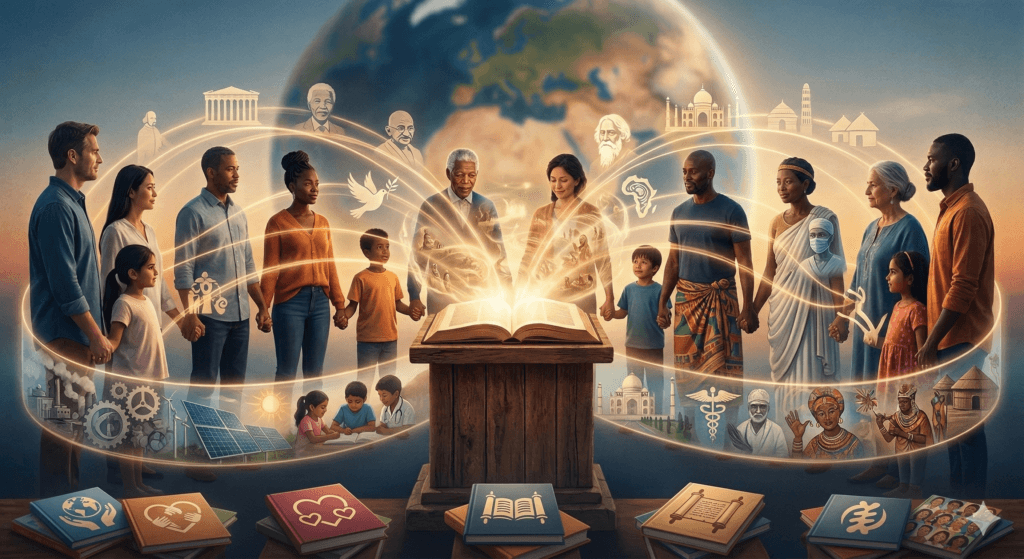
And stories and story tellers can build it!
We still divide the world into “us” and “them.” But our stories can change this!
Every culture already offers a wise blueprint: Whether it is the Marathi wisdom of “He Vishvachi Maze Ghar” (The whole universe is my home) or the Sanskrit truth of “Vasudhaiva Kutumbakam” (The world is one family), the message is identical. From the African philosophy of Ubuntu which says “I am because you are” to the Stoic idea of being a “Citizen of the World,” ancient wisdom tells us that we cannot be truly secure until everyone is.
If the circle of “us” is to grow, it must begin at home, with the stories we tell our children.
So we have to tell them the Ramayana and Mahabharata, but also stories from other cultures. Tell them about Bhagat Singh and Gandhi, but also Nelson Mandela and Martin Luther King Jr. Let them admire Sachin Tendulkar, but also Serena Williams and Roger Federer. Alongside Tagore, introduce them to Shakespeare and so on.
When children hear stories only from one place, their world stays small. When they hear stories from everywhere, humanity becomes the hero.
And that may be where peace truly begins, not in treaties or war rooms, but in living rooms, classrooms, and bedtime stories.
The world is, and has always been, a single home.
Amit, your article highlights a devastating truth: we have spent $150 trillion on the machinery of death that has led our “future” (our children) straight into rows of graves.
Storytelling is a powerful tool
But while expanding our stories is a necessary step, we must look deeper at the internal mechanics that drive a finger to pull a trigger or launch a missile.
In the Bhagavad Gita (3.37), Arjuna asks what force impels a man to commit sin, even against his own will. Krishna identifies the enemy as Kama and Krodha.
In this illusory world governed by Maya, we identify solely with our physical bodies and ego. We are all slaves to our senses. This “me” drives ego and creates a “scarcity mindset.” If my happiness depends on things that gratify my ego and my senses—viz. land, resources, or status—then your possession of those things becomes a threat to my joy. Conflict is the inevitable result of billions of individuals trying to squeeze infinite happiness out of a finite world. As long as we believe that “I am this body,” we will continue to build walls to protect its comforts.
While telling stories of Mandela or Gandhi expands the “circle of us,” it still operates within the realm of Maya (illusion). If we only build a “Human Identity,” we are simply creating a larger ego—a “Global Us” versus “The Environment” or “The Unknown.”
Advaita Vedanta warns that any identity based on the changing world is fragile. If our unity is based on shared culture or mutual trade, it will collapse the moment those resources become scarce. History shows that even “civilized” nations turn on each other when their sensory comforts are threatened. Storytelling touches the mind, but it does not necessarily liberate the spirit from the underlying hunger of the ego.
The solution lies in the Advaitic realization of Atman—the non-dual Self. The Upanishads teach Tat Tvam Asi (Thou Art That). True peace doesn’t come from “tolerating” the other, but from realizing there is no “other.”
The real war is internal. In the Gita, the battlefield of Kurukshetra is described as Dharma-kshetra—the field of righteousness within the heart. The only way to stop the external missiles is to disarm the internal desire for sensory conquest. We must transition from being “consumers of the world” to “realizers of the Self.”
If we do not move beyond the “Human Identity” into a spiritual inquiry that transcends the ego, we remain tethered. Until we begin the spiritual journey to break free from the bondage of our senses, our pursuit of happiness through material means will inevitably result in a cycle of pain and destruction.
Thanks Subir for this wonderful and deeply spiritual insight. The journey towards “The way to stop external missiles by disarming the internal desire for sensory conquest” must begin somewhere. Given that most of the world lives immersed in capitalist attitudes, it’s a difficult task.
So I’ve proposed a less challenging path (though my own path is daunting in the current climate) to guide us towards a better future.
Let the journey begin somewhere.