At the Jaipur Literature Festival this January, I sat in the audience as Gurcharan Das, one of my favourite authors spoke from the stage. One thing he said hit me hard.
“In India, when we buy something from a shop, use an autorickshaw, or visit a hospital, and we pay for it, our first instinct is doubt. Did I just get cheated?“
Think about that. Most of our transactions begin with suspicion. The customer walks in thinking, “This man will cheat me.” The shopkeeper watches and thinks, “This customer will cheat me.”
We are a low-trust society. And we pay a steep price for it. Our transactions leave us hollow, not fulfilled.
Let me tell you two stories.
The Family Doctor
There was a doctor in our town. A family doctor, the kind who knew your parents, your children, your allergies, and your fears. He treated families like his own.
Every morning, he left his house and strolled through town, singing bhajans. People greeted him with respect. The sick sought his help. He examined them, then asked to see the medicine box at home. He looked for what was already there. Most times, that was enough for minor ailments.
He never demanded a fee. And people never held back. They gave him money, grains, sometimes even a piece of land.
Then, like the rest of the world, my town “progressed.” It became a proud medical hub. Speciality hospitals sprang up, offering excellent care. And somewhere in that race, people like our old family doctor slipped behind the curtain. No one even noticed.
The Chips Shop in Wayanad
My second story comes from Kerala.
We were in Wayanad. On the busy main road of Kalpetta town sits our favourite chips shop. You can find good banana or jackfruit chips all over Kerala. But we always come back to this one shop.
On one visit, we saw fresh jackfruit chips being fried right there. The fragrance was irresistible. We placed a large order and ended up buying his entire stock.
After we paid, the cashier mentioned casually, that those chips weren’t for sale. The owner had made them for his own family.
We felt awkward. We offered to cancel the order. But the owner, a man who always smiles, insisted we take them. “You come to Wayanad only a few times,” he said. “I’m happy to give you my best.”
These stories feel worlds apart from what Gurcharan Das described that day. And the truth is, stories like these grow rarer by the year.
When we sell something or offer a service, we chase “maximum returns.” We forget about satisfaction. When we pay for something, we again chase “maximum returns” and forget about gratitude.
Our transactions have become purely monetary. Nothing more.
The Ancient Idea of Yadnya
I have been drawn to the Gita lately. I picked up a simple introductory book (‘My Gita’ by Devdutt Patnaik), and I came across the ancient ritual of Yadnya (यज्ञ).
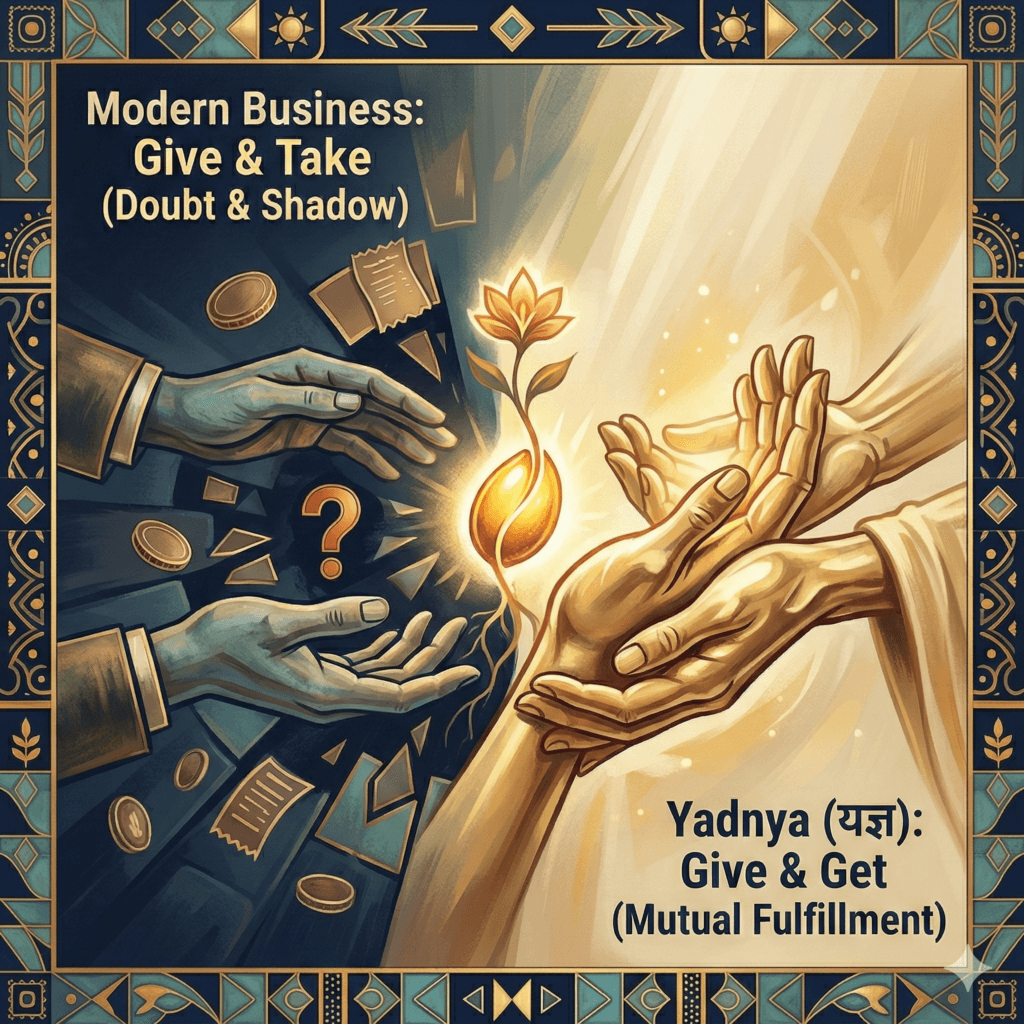
In our ancient tradition, Yadnya addresses exchange, but not the kind we practise today. Human exchange once rose from empathy. From the desire to fulfil someone else’s need. From the trust that someone, in turn, would fulfil yours.
It was not “give and take.” It was “give and get.” A special form of exchange that aimed at satisfaction, for both the giver and the receiver.
The family doctor offered his service for the satisfaction of easing someone’s pain. The chips shop owner ran his business for people’s smiles. These people were doing Yadnya.
How many of us do real Yadnya these days?
When did everything become just a trade?
When did we fix a price for everything, but forgot about satisfaction, contentment, and gratitude?
When did we choose careers only for monetary returns, and stop imagining the fulfilment they could bring?
When did we start paying as per the label, and never as per the joy we received?
When did we stop doing Yadnya and start doing just business?
When did we stop being human?
I am still thinking…..when did we start doing that? And why? And can we stop, or is the toothpaste out of the tube….