On New Year’s Day 2018, WhatsApp crashed. For one full hour. Globally.
The reason? 75 billion wishes flooded the app. India alone sent 20 billion of them. That’s one country bringing the world’s most popular messaging platform to its knees.
But it didn’t stop there. Google engineers noticed something stranger. Every single morning before 8 AM, severe network congestion hit India. Devices crashed. Servers strained. The culprit? Millions of Indians wishing each other “Good Morning.” Every single day.
I have well-wishers who send me Good Morning messages without fail. I appreciate their affection and their dedication. But honestly? I rarely respond. The messages come, I glance at them, and I move on with my day.
Today was different.
Instead of the usual greeting from a familiar name, I saw two words staring back at me: “Deleted Message.”
My heart started racing. My mind filled with thoughts I couldn’t control. What had I done? Had I offended someone without realizing it? Was there some gesture, some word, some unknowing slight that had upset them?
A simple Good Morning never made me feel this way. But a deleted message? It made me restless. Anxious. Curious beyond reason.
That moment got me thinking about the strange nature of instant messaging—and everything it fails to capture.
We don’t communicate with words alone. We use our eyes. Our facial expressions. Our body language. The way we lean in or pull back. A hundred small signals that say more than any sentence ever could.
Here’s an example. I was in the middle of a heavy workday when a friend called. He wanted me to come for dinner that evening. It would have been hard to manage, OPD was piling up, and I was stretched thin. So I politely refused the invitation.
But my friend heard something in my voice. He picked up on the hesitation. He realized I was torn, caught between wanting to go and needing to work. So instead of accepting my refusal, he simply pushed the dinner timing later. That small adjustment made all the difference. I went.
Now imagine that same conversation happening over chat. My “No” would have landed as a firm, final answer. There would have been no flexibility. No reading between the lines. No second chance.
The same words carry entirely different meanings when spoken with different tones, expressions, and gestures. Text flattens everything. It strips away the nuance.
Instant messages miss all of this.
A daily Good Morning might be sent with genuine love and affection. But because it arrives as plain text on a screen, it often fails to convey the warmth behind it. The feeling gets lost somewhere between the sender’s heart and the receiver’s eyes.
But here’s the strange part. While a heartfelt message can fall flat, a “Deleted Message” always ignites curiosity. Always. Without fail. Two words, and suddenly your mind is racing with possibilities.
Let me share another story. I once sent my very first article to a magazine publisher. I was excited beyond words, the prospect of seeing my writing in print felt like a dream coming true. Two weeks passed. Then the publisher called.
He asked me to meet him for coffee that evening. He wanted to discuss a few edits. I was thrilled. This was really happening.
But in the afternoon, I received a text. The coffee meeting was cancelled.
My excitement vanished. Doubt flooded in. Was there a change of plan? Did they not like my writing after all? Had they decided to scrap the whole thing? Every worst-case scenario played out in my head. It was depressing.
I tried to focus on work, but my mind kept circling back. Finally, that evening, I picked up the phone and called him.
The moment he answered, I knew. His voice was hoarse and low. He had a sore throat and fever. That’s why he cancelled. Nothing more.
The context changed entirely in that instant. The WhatsApp message had given me nothing, just two cold lines that sent my imagination spiraling. But on the call, I understood the situation before he even finished explaining. His voice told me everything his text could not.
In my last article, I wrote about how relationships built over the internet often fail to provide real dependability. Instant messaging plays a big role in that problem.
Consider this: a survey found that 40% of personal communication now happens through instant messages. Only 29% happens via audio calls. And video calls? Just 7%.
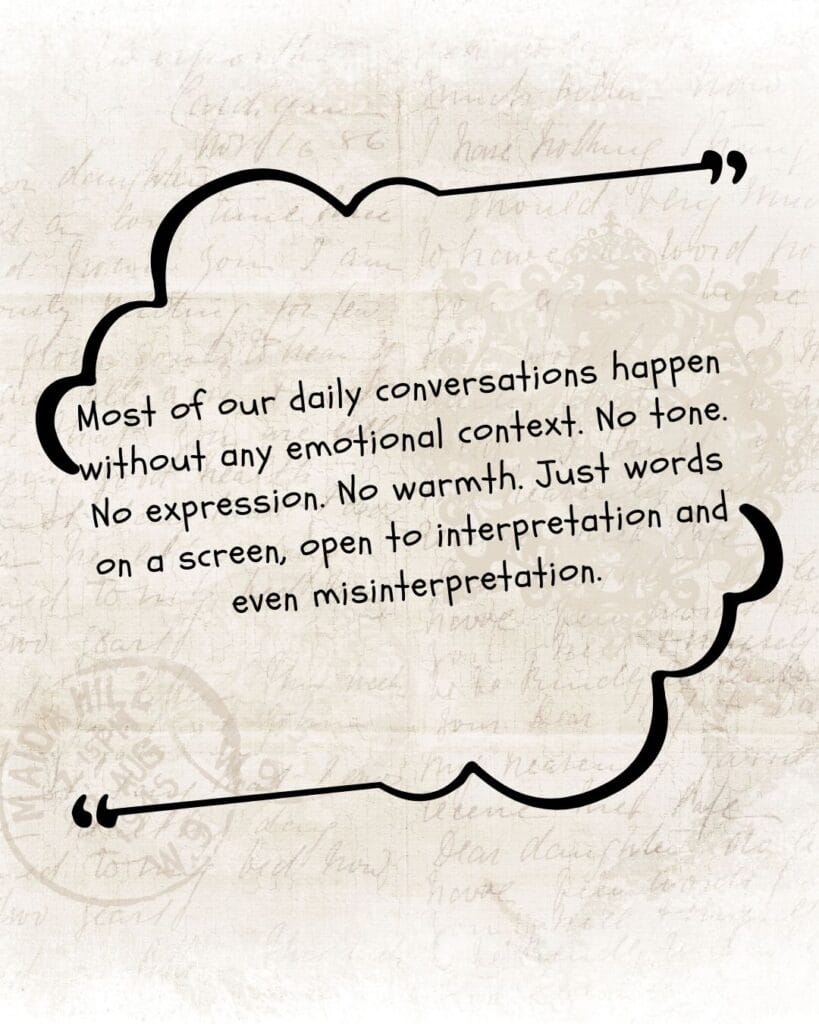
Think about what that means. Most of our daily conversations happen without any emotional context. No tone. No expression. No warmth. Just words on a screen, open to interpretation and even misinterpretation.
Is it any wonder that misunderstandings grow? That relationships suffer? That we feel disconnected even while being constantly connected?
Don’t get me wrong. Messages are useful. They’re quick, convenient, and efficient. But they have clear limits. They fall short when you need to convey real emotion. They struggle when deeper bonds are at stake.
Meaningful conversation requires an exchange of feeling. And feeling travels not just through words, but through your tone, your warmth, your expressions, the way your voice rises and falls.
A daily Good Morning is a kind gesture. I’m grateful for every one I receive. But nothing, absolutely nothing can replace a heartfelt conversation over a phone call. Or a video chat where you can see someone’s face light up. Or best of all, a cup of coffee shared in person.
The next time you want someone to know you care, don’t just type it. Say it. Let them hear it in your voice.
True at a 💯….
We human beings go into assumptions, and making our own meanings and stories and that doesn’t work for our relationships many times……
Agreed. Thank you so much.
Nicely explained the situation and psychology behind it. It is high time for Indians to realise that they are killing their productive time for SM.
That’s true. Thanks for reading and commenting.
Dear Amit
Excellent write up.
With whatsup we connect with many people but very few of them are close to call ans speak. Also it takes a lot of effort to call and speak to someone.
And I feel we should have a few people for whom taking that extra effort makes life worthwhile. Thanks, sir, for reading and commenting.
Cannot Agree More Dr Amit !
Beautifully Penned !
Glad that it resonated. Thanks for your comment.
Amit beautifully written deeply relatable and emotionally honest.
I would add one fundamental element in digital or phone conversations we lose non verbal communication facial expressions, micro pauses, tone shifts, body language.These often carry more emotional truth than words themselves.
Words and language are not inherently perfect tools for conveying emotions and feelings. They carry their own limitations.
Many misunderstandings today are not because of what was said but because of what was not seen not sensed or not emotionally received.
Digital communication gives us language but often takes away emotional context. And emotions by nature are contextual relational and deeply human.
Absolutely agreed. Thanks for the wonderful response.
Nice article Amit,we never think about such small things, that matters a lot.
Thank you so much. Ya perhaps at the middle of the life realising that small things are what matter the most! Your comment means a lot. Thanks once again.